
Data re-typed between tools
The same customer details live in four places, kept in sync by hand.
Spreadsheets, copy-paste between tools, approvals lost in inboxes. We build the software and automation that replaces them — and tell you plainly when an off-the-shelf tool is the better call.
A short assessment with a report you keep. No call needed to see it.
Illustrative concept · sample data
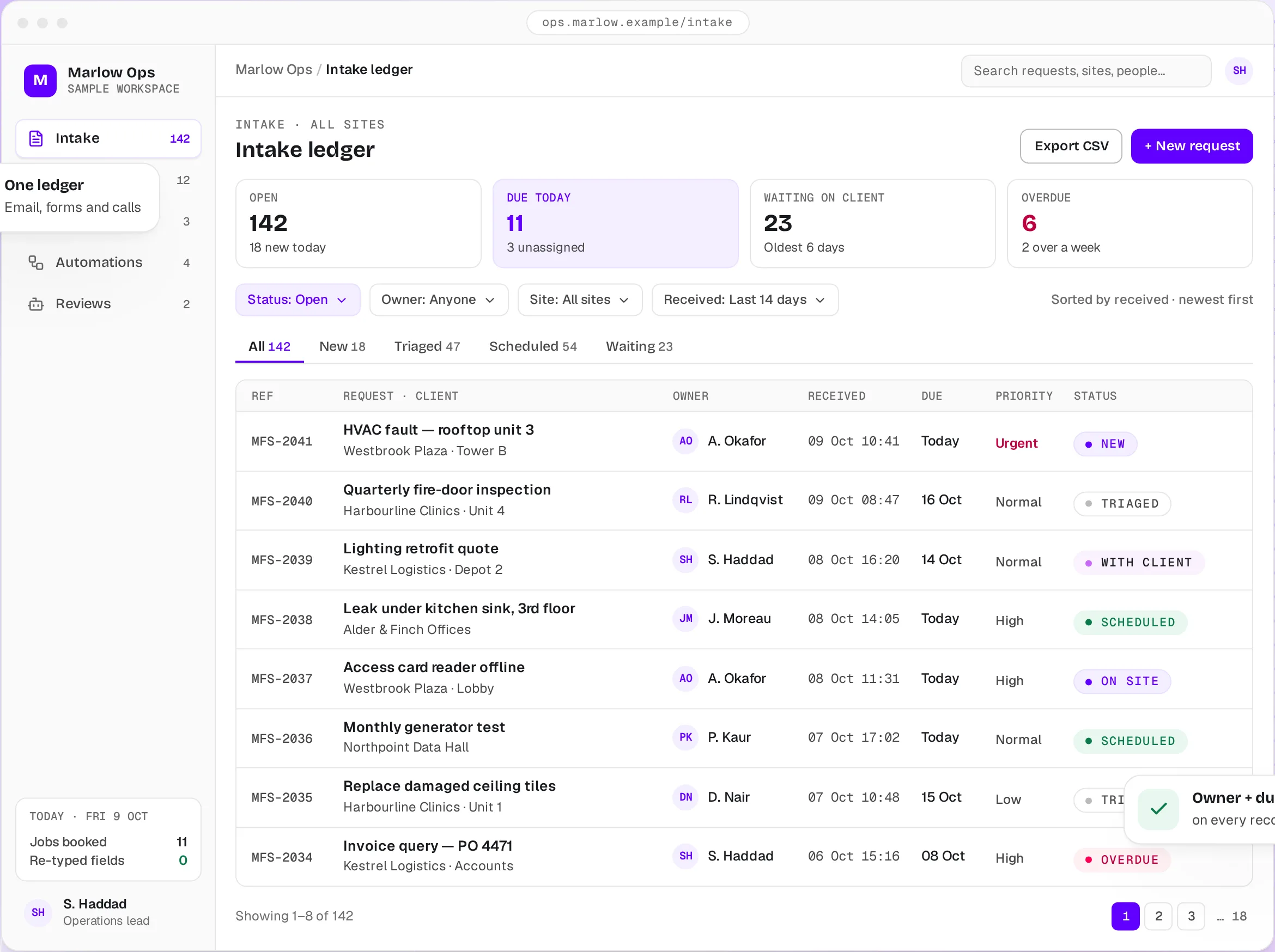
Emails, forms and calls land as one record with an owner, a due date and a status — instead of living in four inboxes and a spreadsheet.
Illustrative concepts on fictional sample data — not client deployments.
Illustrative concept · sample data
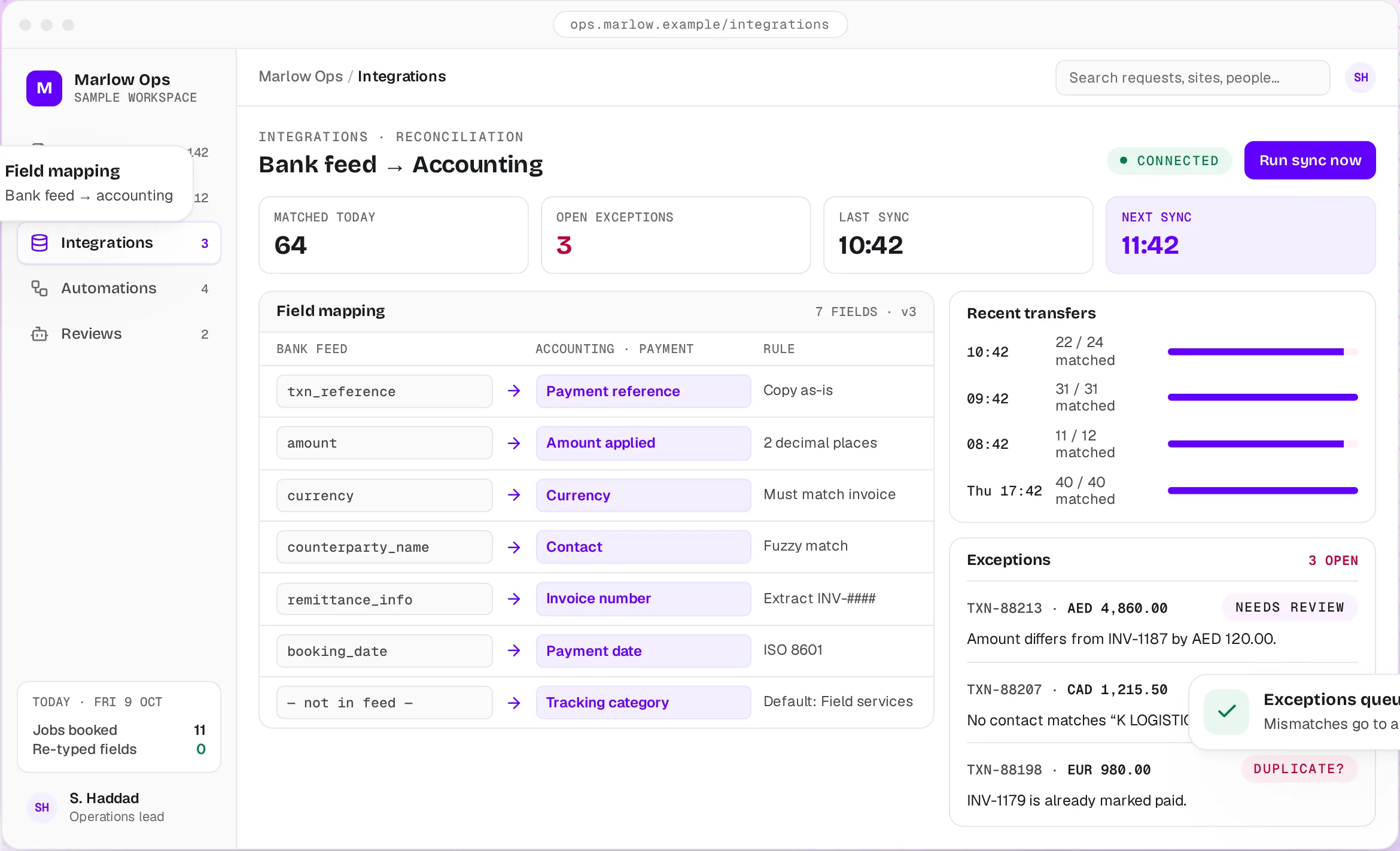
The bank feed and accounting stay in sync through explicit field mapping. Anything that doesn’t match lands in an exceptions queue for a person to resolve.
Illustrative concepts on fictional sample data — not client deployments.
Illustrative concept · sample data
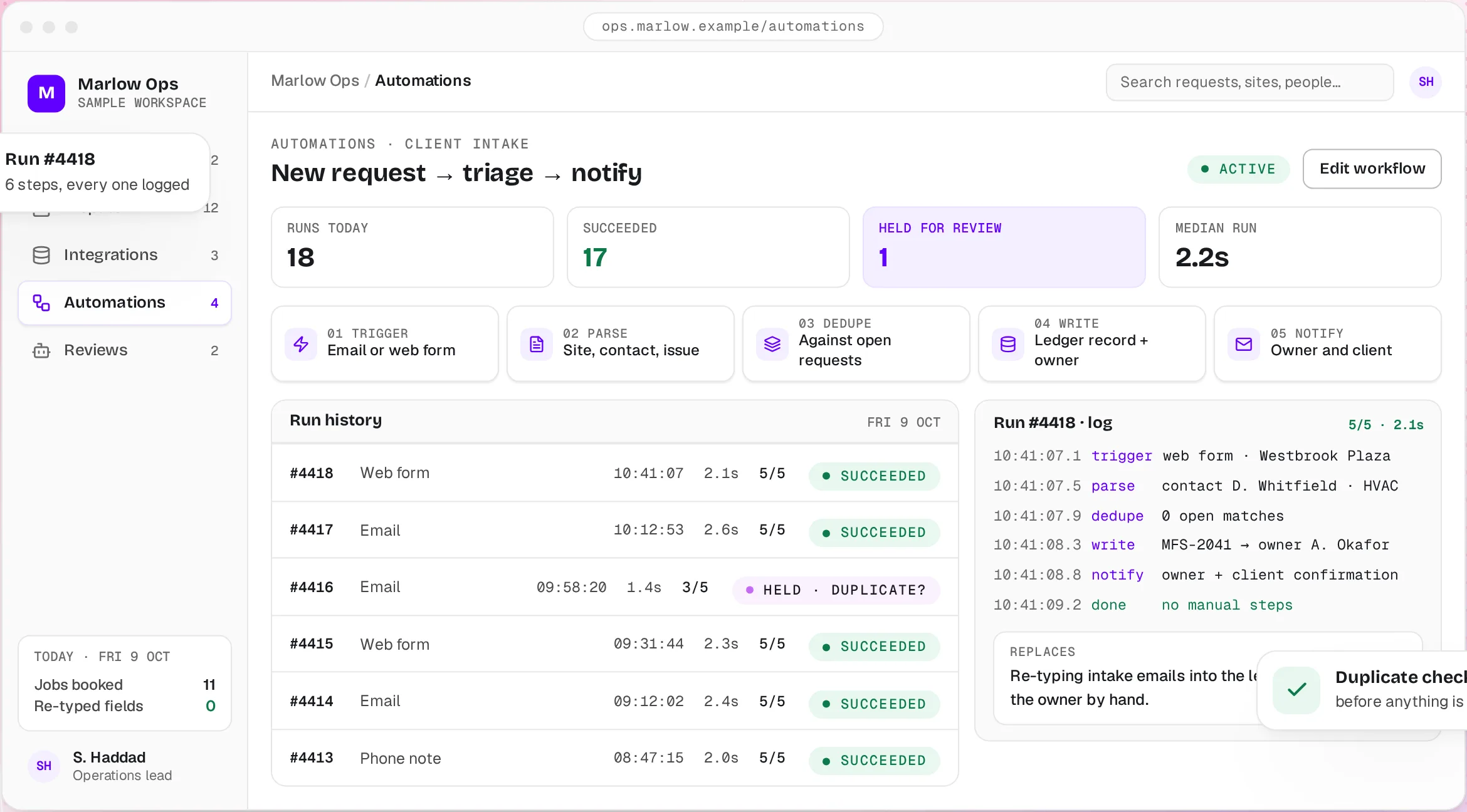
A new request is parsed, checked for duplicates, written to the ledger and routed to an owner — with a run log you can audit.
Illustrative concepts on fictional sample data — not client deployments.
Illustrative concept · sample data
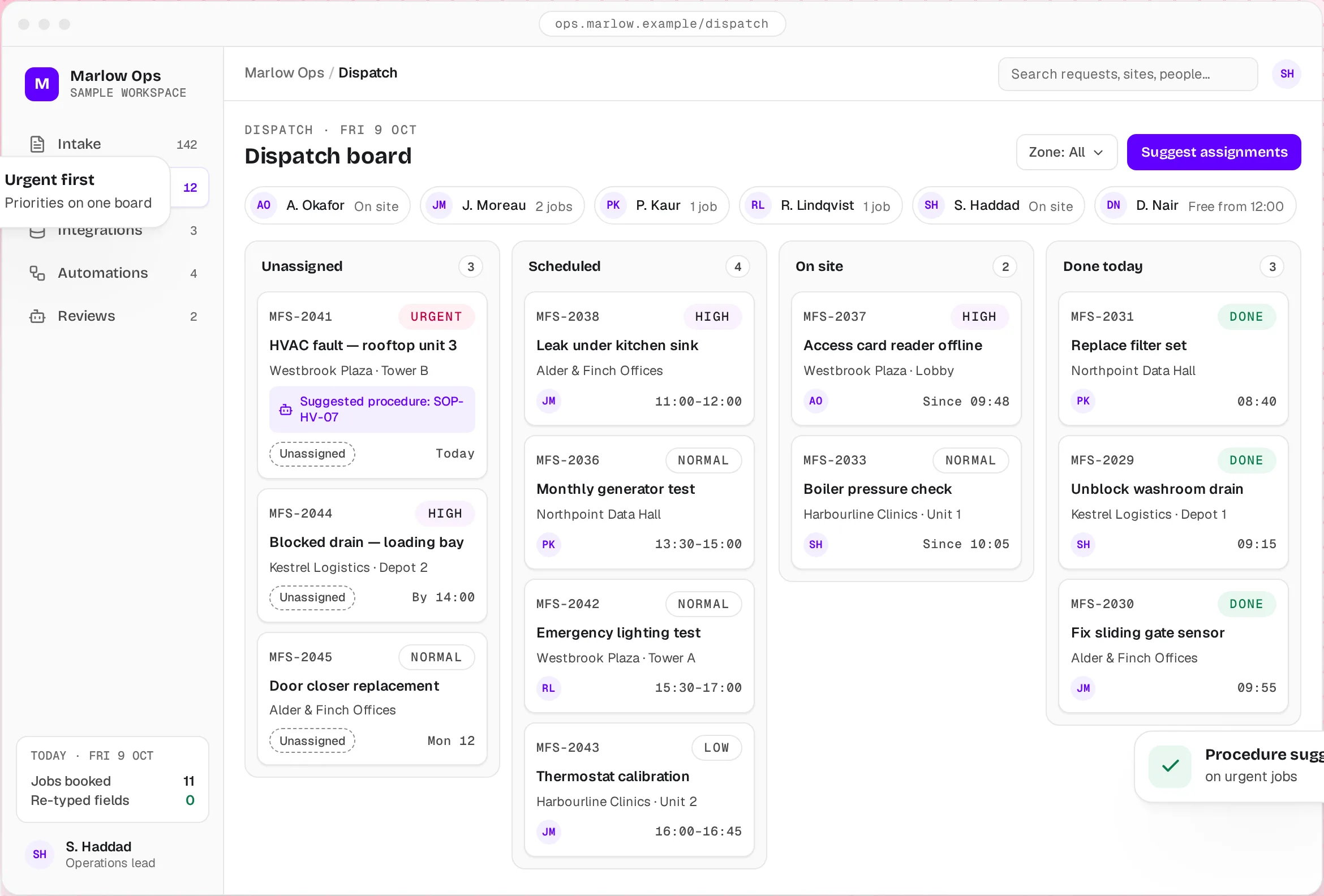
Assignments, priorities and time windows on one board, with the right procedure suggested on urgent jobs.
Illustrative concepts on fictional sample data — not client deployments.
Illustrative concept · sample data
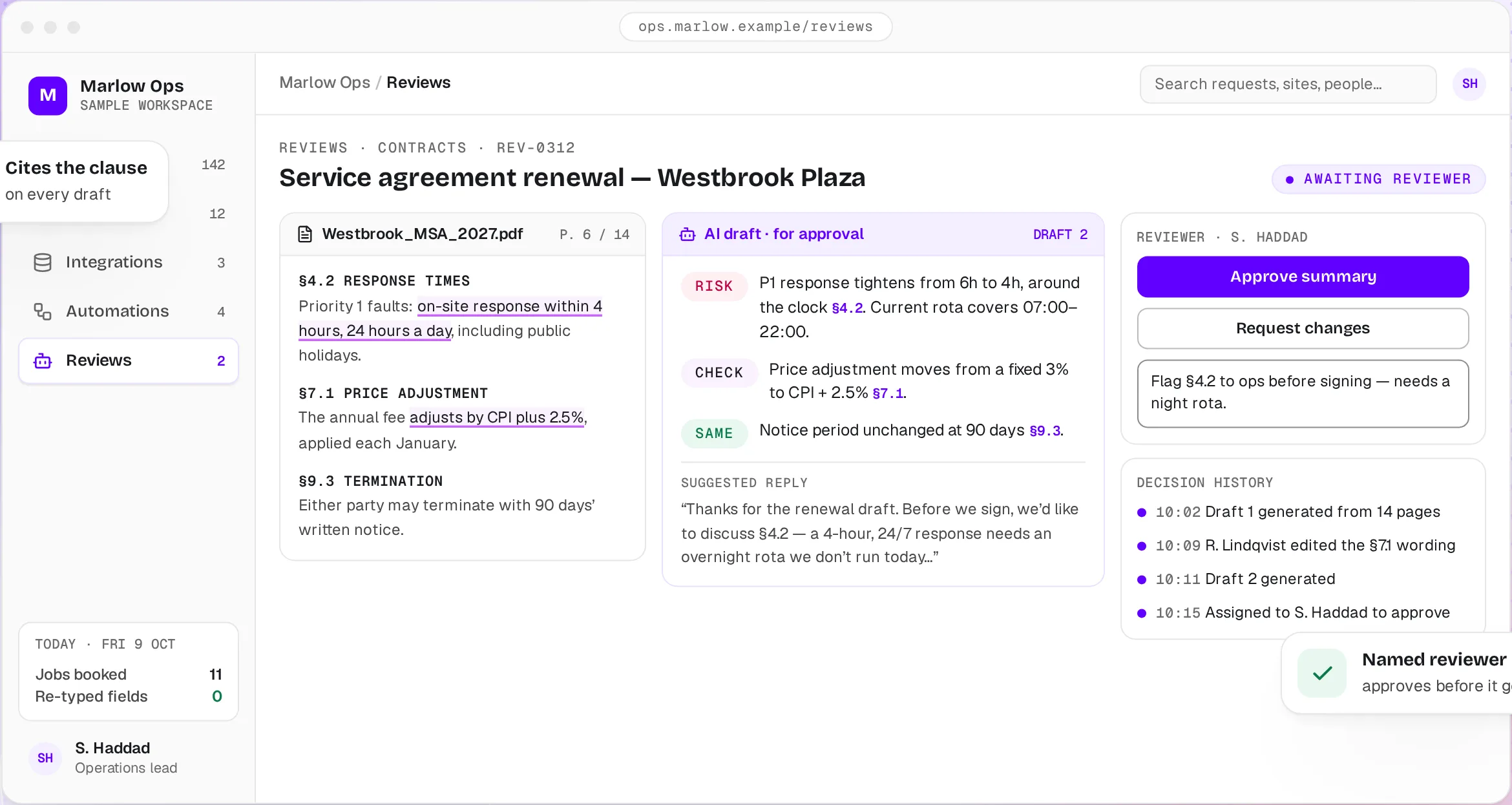
Documents are summarised with citations back to the source clause, and nothing goes out until a named reviewer approves it.
Illustrative concepts on fictional sample data — not client deployments.
Proof you can click
The assessment here isn’t a form that emails someone. It’s a small system we built and run — the same kind of work we do for clients.
Your answers are weighted across decision lenses and turned into a recommendation.
Each report lives on its own link, so you can come back to it, share it and print it.
Submissions land in an admin panel as records with notes — not in someone’s inbox.
Every page is managed through a CMS. Changing the copy doesn’t need a developer.
The cost of disconnected tools
When tools don’t talk to each other, people do it for them — re-typing, forwarding, chasing. The cost rarely appears on an invoice. It shows up as delay, mistakes and work nobody can see.
The same customer details live in four places, kept in sync by hand.
Requests wait on whoever remembers to forward the email.
Monday starts with exporting, pasting and fixing the same spreadsheet.
You bend your process around a tool because the tool won’t bend.
Selected work
Completed client projects — who it was for, what we built, and the manual work it replaced.


A custom tour booking platform for a Bahamas boat-tour operator. Built to replace WhatsApp and walk-up bookings with direct reservations, automated scheduling, and an AI agent that answers guest questions around the clock.
A custom Caribbean media app for NuVision Media. Carib Radio combines verified stations, background playback, news, podcasts, and live shows in one mobile product for listeners at home and across the diaspora.
How many existing systems does this solution need to connect with?
A hybrid approach is right for you.
Build where your process is unique. Buy where you’re solving a solved problem. Automate the seams between them.
Free diagnostic
A short assessment that gives you a straight answer before anyone asks you for a call. Answer questions about budget, timeline, integrations and the patterns that change the maths.
How we work
Each step produces something you can read or click before the next one starts. The first two can begin with the assessment.
We map how the work moves today: who touches it, where it waits, what gets re-typed.
Build, buy or automate — weighed against your budget, timeline and integration load, not our preference.
A written plan covering scope, stack and what ships first. You review it before any code is written.
Working increments you can click, built by the engineer you spoke to.
After launch we stay close: monitoring, fixes, and the next automation worth doing.
Not sure which step you’re at? The assessment covers Understand and Decide on its own — and the report becomes the agenda if we talk.
Fit
A quick read on whether a conversation is worth your time — before you spend any of it.
We already pay for a lot of software.
Good. The cheapest fix is often connecting or configuring what you own. The assessment says so when that’s the case.
We don’t have anyone technical.
You don’t need to. Describe the problem in plain language — we translate it into the stack.
We’re not ready for a big project.
Most first steps are small. Start with the assessment — it’s useful on its own, with or without us.
What if we get locked in?
Repositories, infrastructure and credentials are yours. You can take the system anywhere.
Who you’ll work with
Plus Ultra is founder-led. The engineer who scopes your project is the one who builds it — no account managers relaying messages, no hand-off to a team you haven’t met.
Start a conversationHow working together works
Supporting evidence
What we can show today — and how we label what we can’t.
Names are withheld while work is under NDA. Completed projects are listed under Selected work.
Each listed capability appears in delivered or in-progress work.
The same stack behind the assessment, the private report links and the admin panel that receives your answers.
The working day is structured around overlap hours in each region.
Notes from production
Architecture teardowns and lessons from shipping real systems — written by the engineer who built them.
Notes from real builds — what we would tell a client on a call, written down so you can use it without one.
Questions
If yours isn’t here, ask it on the call — or put it in a note.
Ask a questionNot sure where to start?
A short assessment, a straight recommendation, and a report you keep — before you decide whether a conversation is worth your time.
No call needed to see your result